
Otero County Court Records After a Jail Arrest
Criminal cases from Otero County are handled through the Colorado Judicial Branch in the 16th Judicial District. The official Otero County court page lists Otero Combined Court at 13 West Third St., Room 207, La Junta, CO 81050, with public hours Monday through Friday, 8 a.m. to 5 p.m. Court records after an arrest are separate from sheriff booking records because they reflect the filed court case, not just the intake event at the jail.
For custody confirmation, use jail inmate records and Detention Center Booking. For booking photos, use jail mugshots and the sheriff records request process. For filed criminal charges, hearing dates, bond orders, warrants tied to a case, and dispositions, use Otero Combined Court, Colorado Judicial Branch records requests, docket links, or the paid register-of-actions vendors identified by the Judicial Branch.
The official Otero County Judicial Branch page shows the local court links for docket search, records requests, online payments, virtual courtrooms, and related court services.
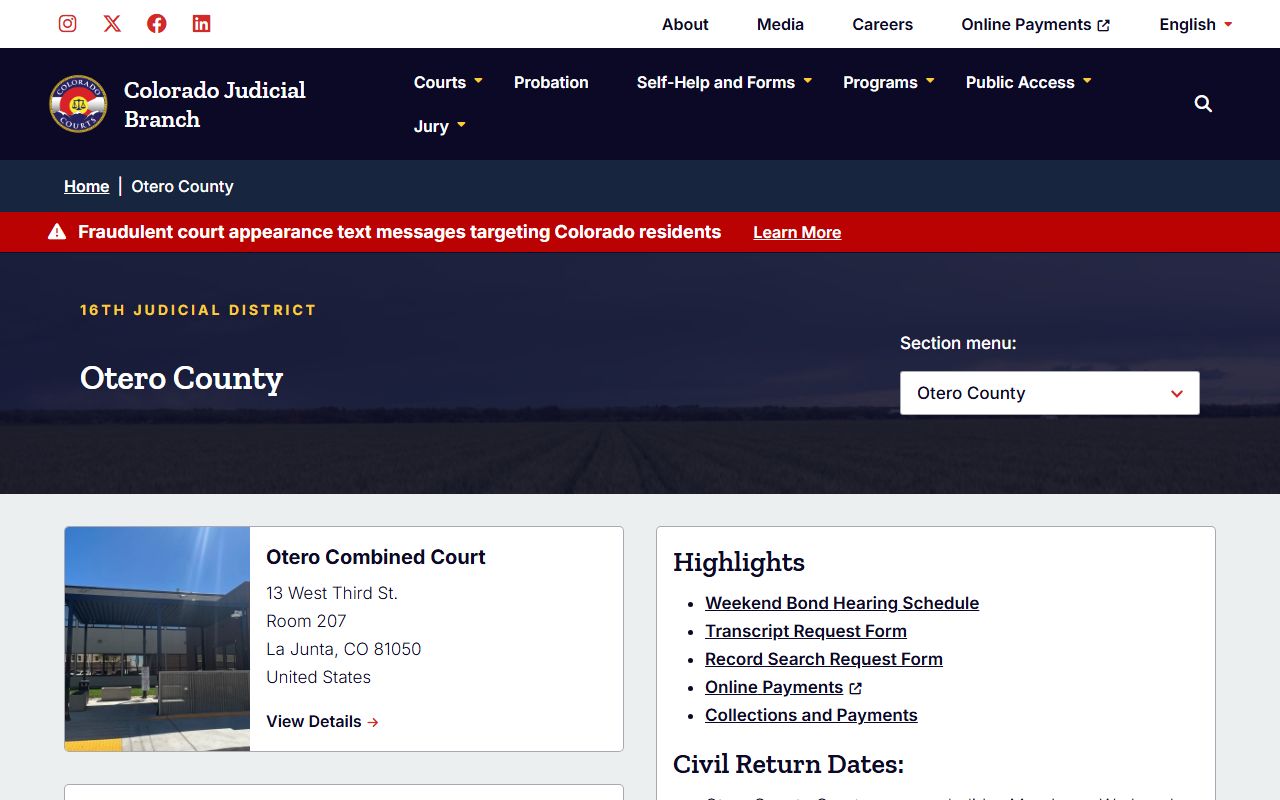
Those court links are the starting point once an arrest has become a filed case rather than only a jail booking.
How to Find Otero County Court Records After an Arrest
Start with the court system when the question is about filed charges, case number, hearing date, bond order, warrant, disposition, or certified copies. The jail can confirm custody, but the court is the source for the criminal case record after an arrest.
- Open the official Otero County Judicial Branch page and use the docket or record-search request links.
- Search or request by defendant name, case number, or known hearing information.
- Use the register of actions to identify charge entries, hearing events, and case status, understanding that vendor results are not certified document copies.
- Request official documents from Otero Combined Court or through the Colorado Judicial Branch online records request route.
The Colorado Judicial Branch access guide says users may contact the court where the case was filed, complete an online records request, or use listed commercial vendors for real-time register-of-actions searches. It also says commercial sites do not provide copies of documents; official copies come from the court or Judicial Branch records request.
The Judicial Branch public-records access guide explains the difference between register-of-actions searches and official court document copies.
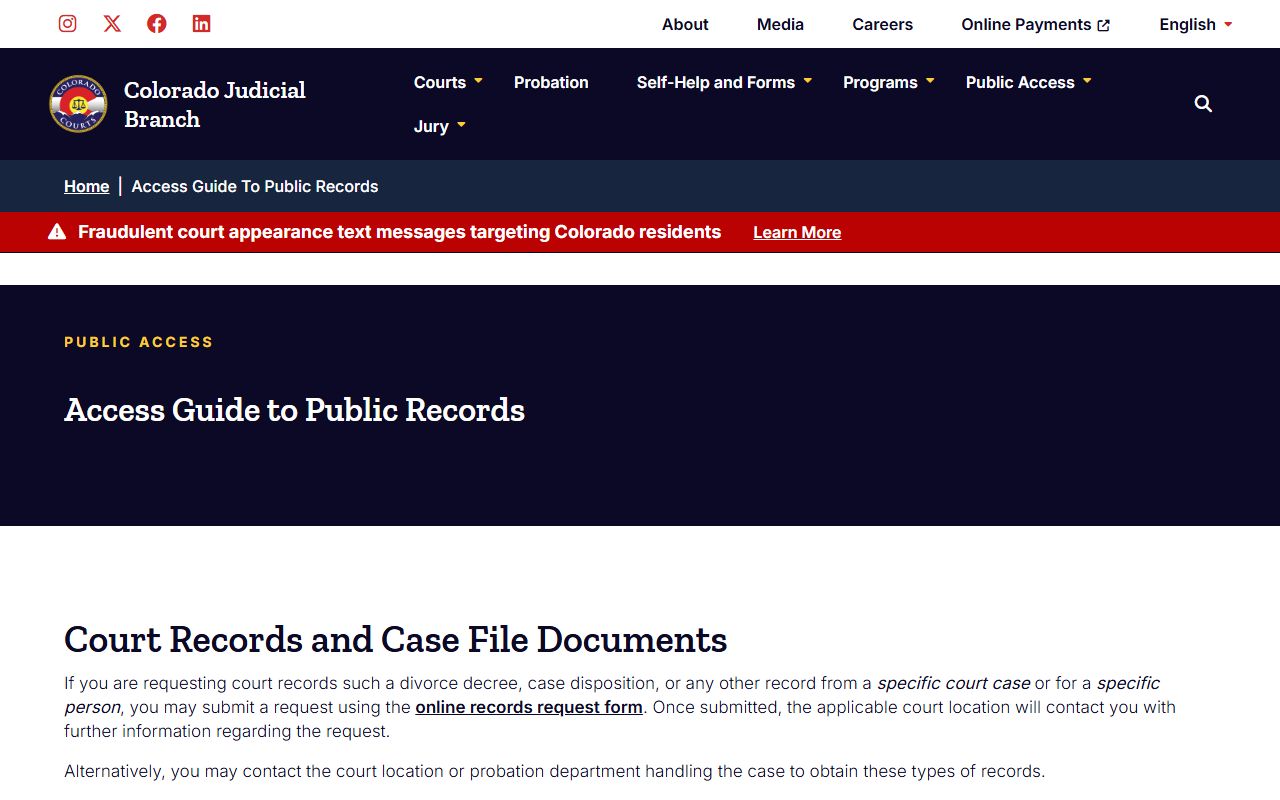
That distinction is important for Otero County court records after a jail arrest because a vendor search may help locate a case, but the court remains the source for official documents.
How Charges Become Court Records After an Arrest
The arrest-to-court path usually starts with law enforcement booking the person into Otero County Detention Center. The jail record may reflect arrest allegations, warrants, or holds. The 16th Judicial District Attorney then decides what formal state charges to file. Those filings create the court record and may differ from the arrest allegations listed at booking.
| Complaint | Information | Indictment | |
|---|---|---|---|
| Filed By | Officer or prosecutor, depending on procedure | Prosecutor | Grand jury |
| Common For | Early criminal filing or misdemeanor-style case starts | Many felony prosecutions | Serious or grand-jury-reviewed felony matters |
| Starts | A court case or initial charge record | A formal prosecution in court | A court case based on grand-jury charges |
Charge Status in Court Records After an Arrest
Charge status changes as a case moves through court. A booking charge is not a conviction, and it is not always the charge that remains in the court file. Prosecutors may amend, reduce, add, or dismiss counts; the court record should be checked charge by charge rather than reading the arrest as the final outcome.
| Status | What It Means |
|---|---|
| Pending | The case or charge is still unresolved. |
| Amended | The prosecutor changed the charge language, count, or statutory theory. |
| Reduced | The charge was lowered, often through negotiation or plea handling. |
| Dismissed | The charge was removed by prosecutor or court action. |
| Disposition | The final recorded outcome for a charge or case. |
| Deferred judgment | A conditional outcome that may later be dismissed if requirements are met; verify the court file. |
Bond and Release After an Arrest
Otero County's jail page does not publish detailed bond-posting instructions. For live bond status, start with Detention Center Booking at 719-384-5941 option 3, then confirm the actual court order with Otero Combined Court at 719-384-4951. The Otero court page links a weekend bond hearing schedule and online payment resources, but the official jail materials reviewed do not list accepted bond payment methods, after-hours bond rules, or property-bond instructions.
| Bond Type | How It Works |
|---|---|
| Personal recognizance / PR | Release based on a promise to appear, possibly with court-ordered conditions. |
| Cash bond | Money posted as required by the court; confirm payment location and method locally. |
| Surety bond | A licensed bail agent posts bond if allowed by the court order. |
| Property bond | Property is pledged if allowed; no Otero-specific instructions were located. |
| No-bond / hold | Release is blocked by statute, warrant, judicial order, another agency, parole, probation, federal, or ICE hold. |
Warrants That Lead to an Arrest
No official Otero County Sheriff active-warrant search or warrant list was located. Warrant questions should go through official phone or court channels: Otero County Sheriff's Office non-emergency at 719-384-5941, Detention Center Booking at 719-384-5941 option 3 for custody after a warrant arrest, Sheriff Dispatch at 719-254-3344, and Otero Combined Court at 719-384-4951 for filed cases. Municipal issues may involve La Junta Municipal Court at 719-363-1246, Rocky Ford Police/dispatch at 719-254-3344, or Fowler Police at 719-263-4461.
A warrant arrest can create both jail and court records. The jail record addresses custody and holds, while the court record explains the case, warrant, bond order, and hearing schedule. Paying bond in one case may not release a person if another hold remains.
Charges vs. Convictions
An arrest and a filed charge are accusations. A conviction requires a guilty plea, verdict, or other qualifying court disposition. Court records after a jail arrest should therefore be read for status and disposition, not just the initial charge list.
| Charge | Conviction | |
|---|---|---|
| Stage | Accusation filed or alleged | Final guilt finding, plea, or qualifying disposition |
| Proof Level | Probable cause or charging decision | Beyond a reasonable doubt or admitted by plea |
| Record Meaning | Shows what was alleged in court | Shows the charge resolved as a conviction |
Sealed vs. Expunged Arrest and Court Records
Colorado court and criminal justice records can be limited by statute, court rule, court order, juvenile law, and public-access policies. The research points to C.R.S. 24-72-301 et seq. for criminal justice records, Chief Justice Directive 05-01 and public access rules for court records, and C.R.S. 19-1-301 et seq. for juvenile record availability. Eligibility for sealing or expungement depends on the case type and disposition, so the filed court record and current law must be checked before assuming public access.
| Sealed | Expunged | |
|---|---|---|
| Public Visibility | Hidden or restricted from ordinary public access by rule or order. | Treated more strongly as removed or unavailable, depending on the statute. |
| Agency Access | Some government or justice-system access may remain. | Access is more limited and statute-specific. |
| Otero Handling | Verify with Otero Combined Court or the record custodian. | Verify eligibility and effect through the court or legal counsel. |
Public Access Laws for Court Records After an Arrest
Colorado separates ordinary open records from criminal justice and court records. CORA, C.R.S. 24-72-203, addresses inspection and copying of non-criminal-justice public records. The Colorado Criminal Justice Records Act, C.R.S. 24-72-301 et seq., governs criminal justice records held by law enforcement, courts with criminal jurisdiction, CBI, and correctional agencies. C.R.S. 24-72-305 allows denial when release is prohibited or contrary to public interest, and Otero sheriff requests require a pecuniary-gain certification under C.R.S. 24-72-305.5.
The Judicial Branch access guide also notes that vendor register-of-actions data does not constitute the official court record and may not include every case type. If a record looks wrong, the official correction route is the court where the original record was created and filed.
Background Check Considerations
Court records can be useful for personal case tracking, family information, or locating a hearing. They are not a substitute for a legally compliant consumer report. Employment, tenant screening, credit, insurance, and similar decisions require FCRA-compliant sources and procedures.
Important: This site is not a consumer reporting agency and must not be used for FCRA-covered screening decisions.
Restricted Court Records After an Arrest in Otero County
Some records may be unavailable, delayed, redacted, or restricted. Examples include juvenile matters, sealed charges, sensitive victim information, sex-assault records, open investigations, and records controlled by court order. The Otero sheriff records form itself flags juvenile involvement and sex assault as categories needing special review. Court documents should be requested from Otero Combined Court or the Judicial Branch records process rather than assumed available through a vendor search.
District Attorney Role After a Jail Arrest
Otero County is in Colorado's 16th Judicial District with Bent and Crowley counties. The Governor's Office announced that James R. Bullock became District Attorney for the 16th Judicial District effective April 13, 2024. The district attorney decides what formal state charges to file after an Otero County arrest, and those decisions shape the court records that follow. An official standalone district attorney contact page was not located in the research pass, so filed-case questions should route through Otero Combined Court records and official Judicial Branch channels.
The Otero Combined Court location page provides the local court address, phone, fax, and hours for records and filed-case questions.
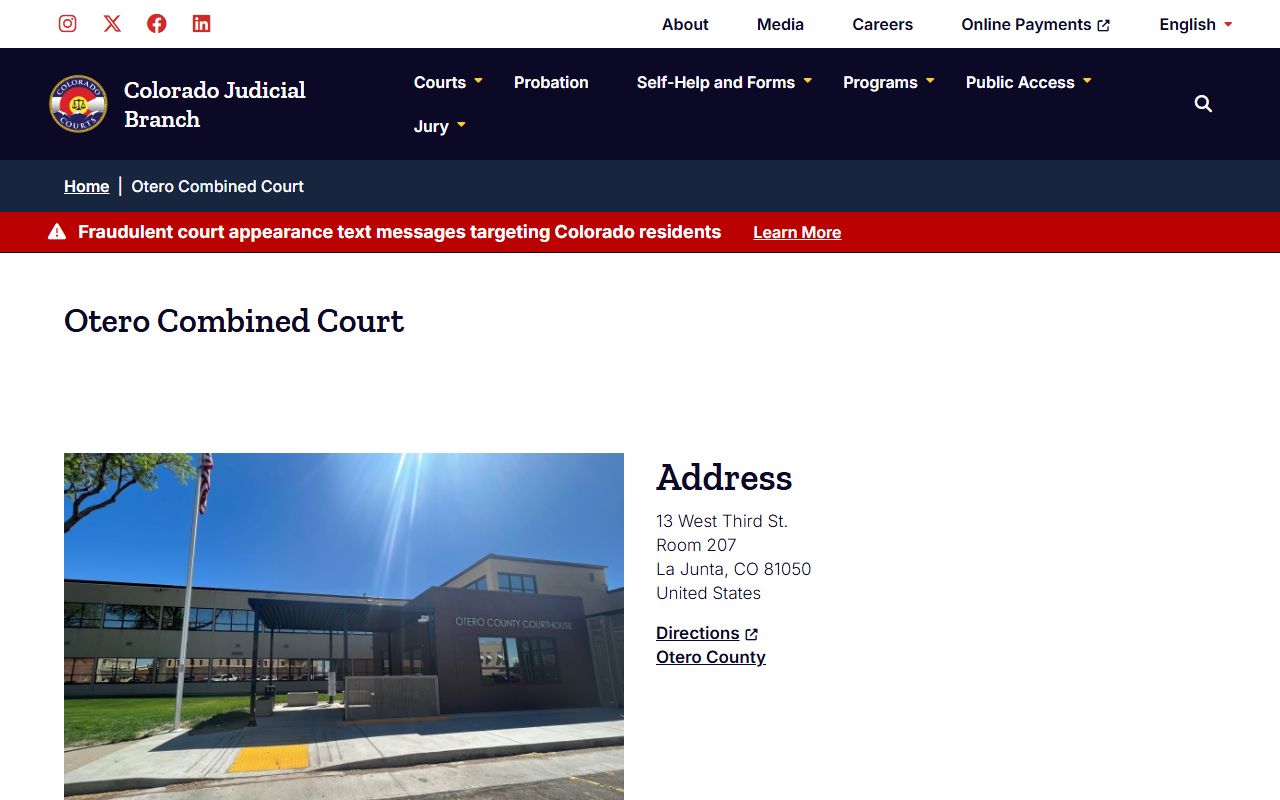
Use the court location details when a court record after an arrest requires clerk confirmation, document copies, or current hearing information.